Manganese is an essential trace element. It must be ingested daily in low amounts and is active as a co-factor or central atom in enzymes that fight oxidative stress. However, too much manganese can cause brain damage similar to Parkinson’s symptoms.
Distribution and effects in the body
Manganese is absorbed in its compounds, mostly as oxides, through food. About 10 % of the manganese contained in the diet enters the liver via the small intestine and is then distributed to the organs that require it
. These processes of
absorption and distribution are highly regulated, so there is no risk of ingesting too much manganese via this route of
absorption. The situation is different when
exposure occurs via the lungs and larger amounts are inhaled. Manganese-containing dusts, which are produced at the workplace for example and can be inhaled, also lead to
exposure of the deep parts of the lungs. There, manganese can be absorbed very well. In addition, particles containing manganese also reach the olfactory bulb, an anterior part of the brain, directly via the olfactory mucosa in the nose (see
Nanoparticles and the olfactory mucous membrane). This direct route into the brain bypasses the blood-brain barrier and leads to high exposure of the forebrain and subsequently the entire brain
. Since transport into the brain is very rapid, prolonged exposure to manganese will inevitably lead to its accumulation in the brain
. There, an overdose of manganese causes an opposite effect to the desired combating of
oxidative stress: too much manganese increases oxidative stress! This permanent increase in the
concentration of oxygen radicals causes nerve damage, which leads to typical effects; rapid fatigability, sleep disturbances, muscle pain and hypertonia, mask-like face, gait changes, coordination disorders, hallucinations and mental irritability are among the symptoms
.
Moreover, the effects are almost independent of the speciation of the manganese. For manganese (II,III) oxide (Mn
3O
4), an
inflammatory effect was described after exposure of mice via the lungs at relatively low concentrations
and the same effect was observed after administration of the same amount of manganese (III) oxide (Mn
2O
3)
. In rats, transport to the brain and neuronal effects were also demonstrated after exposure of the lungs to manganese dioxide (MnO
2), but at a much higher
concentration . All these experiments were performed with nanoparticulate manganese oxides.
For the manganese dioxide (MnO
2), it was also shown that after oral intake of high amounts of the manganese dioxide, there was an increased transport to the liver and from there the distribution could also be detected to the brain, which led to significant effects in the treated rats
. However, the authors of the studies clearly emphasized that these concentrations do not reflect reality, as this does not correspond to the daily intake in humans.
Uptake and effects in cells
Several
in vitro studies have investigated the biochemical processes in cells after manganese oxide treatments, and different oxides of manganese were also used. Manganese dioxide (MnO
2) triggered oxidative stress at low concentrations compared to other metal oxides in nanoform
. In
in vitro experiments, human neurons formed reactive oxygen radicals and increased their
antioxidant capacity. Nevertheless, the nerve cells were damaged and began to die.
Manganese (III) oxide (Mn
2O
3) did have varying effects depending on the cell types, but effects were more limited to lung
epithelial cells. Thus, phagocytes of the lung were little affected by the addition of this manganese oxide and the authors of the study were surprised that the effect was so small
. For the
epithelial cells of the lung, the situation was more comparable to the results obtained in animal experiments, the manganese (III) oxide was
cytotoxic and induced oxidative stress in the cells
. Epithelial cells
but also human neurons
also reacted with
apoptosis in vitro. In turn, Mn
2O
3 had a much smaller effect on very specific immune cells of the lung, so-called dendritic cells, and on the cells in a 3D lung model. After treatment with 70
nm manganese (III) oxide particles, only certain proteins on the plasma membrane of the dendritic cells increased, otherwise no
harmful effects were observed in the 3D model
.
The third variant of manganese oxides studied, Mn
3O
4 (manganese (II,III) oxide), also leads to a corresponding reaction in lung epithelial cells due to oxidative stress. A systematic study dealt with the alteration of an important electronic state of the compound by the addition of other elements to the nanoparticles. The
toxic effect and the triggering of oxidative stress in both lung epithelial cells and
macrophages depended directly on a change in this property
, which was cited as an example for the fabrication of “safe-by-design” particles (compare
Spotlights March 2022 and
Spotlight November 2021). However, the pure Mn
3O
4 had a clear effect on epithelial cells of the lung and the typical effects such as oxidative stress, cell death, etc. were also observed here
. In this comparison, the nanoparticulate manganese oxide was significantly better taken up by the cells than dissolved manganese salts.
Due to its redox potential, manganese has effects especially in connection with reactive oxygen species. In low amounts incorporated in certain enzymes in the body manganese positively counteracts oxidative stress. However, increased concentrations of manganese have exactly the opposite effect: too much of it in the body increases oxidative stress, which can have serious consequences, especially in nerve cells of the brain. The cells partially die and manganism occurs, which are Parkinson’s-like symptoms.
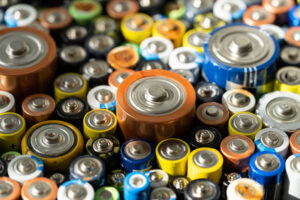 Because manganese and its oxides occur everywhere in nature, e.g. in rocks, they are ingested through food. Steel cutlery also contains manganese.
Manganese dioxide (MnO2) is used in alkaline batteries, so if you destroy a battery you could come into contact with it. Since batteries also contain other substances that are not beneficial to health, they should not be opened. This also applies to lithium-ion batteries, which contain not only manganese but also other substances that are harmful to health, such as cobalt or nickel. Manganese is used as a nanoscale material in solar cells, but here it is encapsulated and is thus not released during use.
Because manganese and its oxides occur everywhere in nature, e.g. in rocks, they are ingested through food. Steel cutlery also contains manganese.
Manganese dioxide (MnO2) is used in alkaline batteries, so if you destroy a battery you could come into contact with it. Since batteries also contain other substances that are not beneficial to health, they should not be opened. This also applies to lithium-ion batteries, which contain not only manganese but also other substances that are harmful to health, such as cobalt or nickel. Manganese is used as a nanoscale material in solar cells, but here it is encapsulated and is thus not released during use.



 Manganese is an important element and has great significance not only in the steel industry, but also biologically. It is one of the so-called “essential trace elements”, similar to iron, copper and zinc. It is important for us humans because, as a co-factor in enzymes, it ensures, for example, that oxygen radicals are neutralized, thus counteracting
  In contrast to the everyday situation, certain workplaces are much more frequently exposed to manganese-containing dusts or particles.
  The human body replenishes its reservoir for manganese through food, i.e. the manganese is transported from the food in the small intestine into the body and distributed via the liver to other important organs that require the manganese for the function of certain enzymes. The daily intake ranges from 1 to 5 mg for an adult. It should be kept in mind that only about 10 % of the manganese contained in food is absorbed. The vast majority of 90 % is directly excreted . However, there is enough manganese in the diet so that no deficiency occurs in European countries. The manganese absorbed via the small intestine is not transported to the brain.