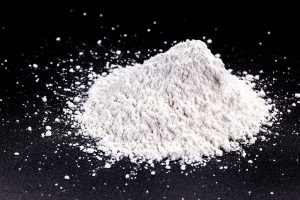
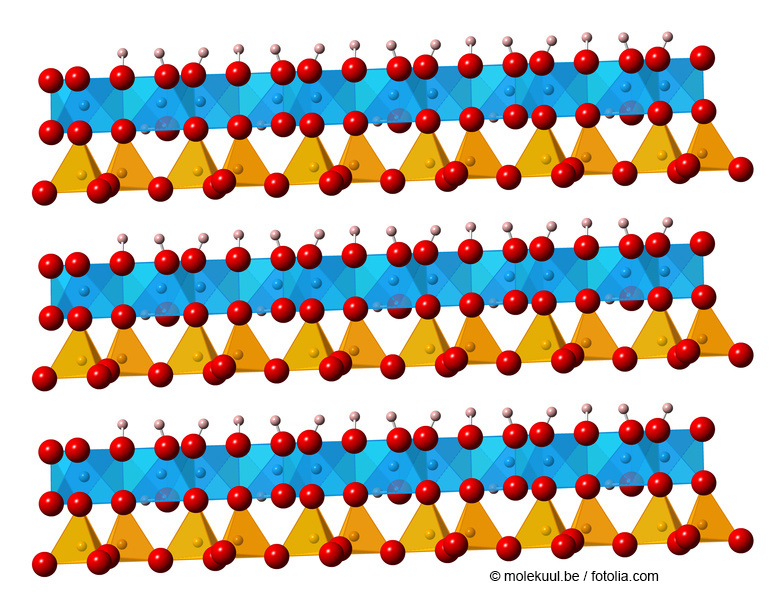
Since clays and nanoclays are found in a wide variety of applications, their possible effects in the organism are an important issue. When nanoclays are inhaled into the lungs as dust particles, they can cause inflammation. Via other uptake routes (ingestion or dermal) they have hardly any effects. In isolated cells, they have an effect only at very high concentrations. If organically modified, they can be effective at lower concentrations.
Distribution and Effects in the Body
Inhalation of dust can be hazardous to health. This also applies to dust particles from nanoclays. It has been shown both for humans and in animal experiments that large quantities of nanoclays in the lungs lead to
inflammation.
Exposure over two to four years to high concentrations of bentonite dust in the workplace (8 to 13 mg/m
3) was shown to cause DNA damage in lung cells in Chinese workers. Although the statistics in this study are not sufficient, such an effect can certainly be assumed, since clay particles may have portions of
crystalline quartz. Quartz also has such a DNA-damaging effect
.
Already in 1993, similar effects were demonstrated in a study on Spanish workers. However, a different clay was processed here, sepiolite, a fibrous clay material
. This can be critical because of its fibrous form (see cross-cutting text
Airborne Fibres). The same material was tested on rats in animal experiments. There, a temporary inflammation occurred in the lungs, but this subsided after one week
. Further effects on internal organs were not demonstrated. But so-called
multinucleated giant cells were formed, which can be of importance in
pneumoconiosis, among other things (compare
Silicon Dioxide).
Further studies that introduced nanoclay particles into the lungs of mice and rats by
instillation showed a comparable inflammation-inducing effect for bentonite. This was similar in magnitude to treatment with quartz. In contrast, kaolin was significantly weaker in its inflammatory effect
.
If the occupational limit value for respirable dust in the workplace is observed, no health hazards to workers are to be expected.
Clays are also used as additives in animal feed. Therefore, the
absorption and effect in the gastrointestinal tract was studied in mice and rats. Montmorillonite was added to the feed in large amounts (1000 mg/kg body weight in rats
, and up to 5700 mg/kg body weight in mice
in its pure form or after organic modification. Subsequently, it was investigated whether there could be inflammatory effects or the clay particles are absorbed into the body and affect other organs. In both studies, no damage or inflammation was observed, neither in the gastrointestinal tract itself nor in internal organs such as the liver or kidneys.
Although the clay particles have rather positive effects, e.g. as feed additives, it is certainly discussed that their property to bind specific ions or substances with a flat molecular structure leads to the animals showing deficiency symptoms in e.g. trace elements or vitamins
. Thus, care must be taken to ensure that there is a balance in the feed between the added clays and the trace elements or micro-nutrients so that such deficiencies do not occur. However, the addition to the feed in Europe has been considerably restricted since May 2021, or the approvals in the EU register for feed additives have not been renewed in some cases.
Uptake and Effects in Cells
Toxicological studies on clays and nanoclays in cell cultures have been carried out mainly with two representative types: the bentonites, which include montmorillonite, and the kaolins, which include halloysite. Since these substances (mainly bentonite/montmorillonite) are approved as feed additives, but are also used in food packaging materials, it is important to understand their effect on the organism.
Halloysite was tested in liver and lung cells. Halloysite tubes between 200
nm and 1
micrometer in length showed little
toxic effect and the cells responded only at high concentrations (50 – 100 µg/ml) and after three days of treatment. Lung cells are slightly more sensitive in this regard, but also only after several days of treatment with 20 and 40 µg/cm
2 . The same group also investigated kaolin on another lung cell line. However, this was again much less sensitive and showed first cell
toxic effects only at 100 µg/ml and above after five days of treatment. These studies indicate that kaolin has only a low toxic effect on cells
..
The results for bentonite or montmorillonite are comparable. The eight good-quality studies of the last two decades essentially state that pure bentonite/montmorillonite can hardly induce toxic effects in different cells. Skin cells, liver cells connective tissue cells, intestinal
epithelial cells, Endothelzellen der Nabelschnur, umbilical cord
endothelial cells and
macrophages were studied. Only above 62.6 µg/ml or far beyond, the cells in the experiments showed a loss of their viability after one or more days of treatment. These concentrations are very high and are not reached in the workplace
.
These clays especially nanoclays behave differently when they are chemically modified. The addition of nitrogen compounds (in this case
quaternary ammonium compounds) changes the behavior and also the effect on cells. All studies that have compared pure montmorillonite with an organically modified variant come to the same conclusion, the organically modified nanoclay has a significantly more harmful effect on cells at lower concentrations. However, even with these variants, the concentrations are higher than would be expected in the workplace or even for consumers, so that no immediate risk to humans can be identified
.
No effects of concern were found for clays and nanoclays in both animal and cell culture studies. Even though the organically modified nanoclays have an effect at lower concentrations compared to unmodified nanoclays, the concentrations used are much higher than in the workplace or in consumer products. A genotoxic effect is basically excluded, so that these substances are classified as safe by the European Food Saety Authority (EFSA).
Further information:
- European Commission, Directorate-General for Health and Food Safety (2021). European Union register of feed additives pursuant to Regulation (EC) No 1831/2003. Appendix 4(II), annex II, : List of additives subject to the provisions of Art. 10 § 2 of Reg. (EC) No 1831/2003 for which no application for reevaluation was submitted before the deadline of 8 November 2010 (Released 11.01.2021), Publications Office, 2021, https://data.europa.eu/doi/10.2875/0296
- EFSA Panel on Additives and Products or Substances used in Animal Feed (FEEDAP), Bampidis, V., Azimonti, G., Bastos, M.L., Christensen, H., Dusemund, B., Kouba, M., Kos Durjava, M., Lopez-Alonso, M., et al. (2019). Efficacy of a preparation of algae interspaced bentonite as a feed additive for all animal species. EFSA J 17, e05604. https://doi.org/10.2903/j.efsa.2019.5604.
- EFSA Panel on Additives and Products or Substances used in Animal Feed (FEEDAP), Rychen, G., Aquilina, G., Azimonti, G., Bampidis, V., Bastos, M.L., Bories, G., Chesson, A., Cocconcelli, P.S., et al. (2017). Safety and efficacy of bentonite as a feed additive for all animal species. EFSA J 15, e05096. https://doi.org/10.2903/j.efsa.2017.5096.
- EFSA Panel on Food Contact Materials, Enzymes, Flavourings and Processing Aids (CEF), Silano, V., Bolognesi, C., Chipman, K., Cravedi, J.P., Engel, K.H., Fowler, P., Franz, R., Grob, K., et al. (2018). Safety assessment of the active substances carboxymethylcellulose, acetylated distarch phosphate, bentonite, boric acid and aluminium sulfate, for use in active food contact materials. EFSA J 16, e05121. https://doi.org/10.2903/j.efsa.2018.5121