The term sustainability was already formulated in forestry in 1713. At that time, it described the practice of only felling as much wood in a forest as can grow back again. Later, the term was applied to other economy sectors as well. The so-called Brundtland Report (Report of the World Commission on Environment and Development “Our Common Future”, 1987) was a key impulse for today’s understanding and current relevance of the topic. This formulated the concept of intergenerational equity in sustainable development. Another milestone was the adoption of the 17 UN Sustainable Development Goals in 2015.
What does sustainability mean?
The historical basic idea was always to use natural resources and energy in such a way that the environment can tolerate the use of resources in the long term and regenerate. This means that only as many natural resources are consumed or used as can grow back or regenerate. Non-renewable raw materials (e.g. metals) should only be mined in quantities that cannot be recovered through recycling and thus kept in the cycle.
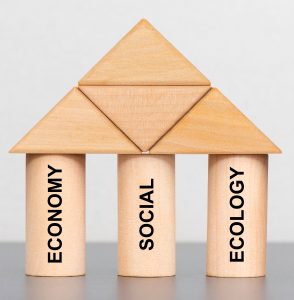
Based on the Brundtland Report, sustainability is now understood as development “that meets the needs of the present without compromising the ability of future generations to meet their own needs and choose their own lifestyles”. Sustainability is always considered for the three pillars of ecology, economy and social issues. These three components are to be regarded as equally important and are mutually dependent.
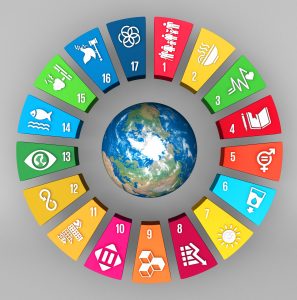
In 2015, the United Nations (UN) formulated 17 Sustainable Development Goals (SDGs) to enable all people to live in dignity while preserving the natural foundations of life in the long term. They include economic, ecological and social aspects, such as equitable access to food, health and education. The fight against climate change, access to affordable and clean energy, the protection of ecosystems and sustainable consumption and production are also enshrined in these goals. Many countries around the world are committed to the Sustainable Development Goals, including the German Federal Government in its sustainability strategy.
Sustainable innovative materials
In many areas, there is high demand for innovative materials with new properties (e.g. battery production, medicine). When developing materials, the focus is often on optimising the respective property and less on sustainability aspects (e.g. degradation conditions for lithium or copper). However, new materials can be designed to be more sustainable by paying attention to the careful use of resources (e.g. saving energy during production) and closing material cycles (circular economy). In order to assess the sustainability of innovative materials, the entire life cycle of a material or product is considered. For example, the conditions during the extraction of raw materials or the energy consumption during the further processing of materials are taken into account. It is not possible to categorise materials as generally sustainable or non-sustainable. It always depends on the specific use of a material. In the case of innovative materials, it is therefore important to identify the most sustainable uses possible, but also to consider the limits of a sensible use.
Sustainability and material safety
The safety of innovative materials for humans and the environment is an important component in assessing their sustainability. This is enshrined in the UN Sustainable Development Goals on Health (3), Industry, Innovation and Infrastructure (9), Sustainable Consumption and Production (12), Life Under Water (14) and Life on Land (15). Only materials and products that do not harm human health and the environment are also sustainable, but on the condition that they also fulfil other sustainability aspects.