The greatest threat to environmental organisms from perovskite solar cells comes from the heavy metals they contain, such as lead or tin, as well as from various acids. The effects of lead and tin on environmental organisms have been well studied and critical concentrations are known. This data can be used to provide an assessment of the risk to environmental organisms from perovskite solar cells. Currently (as of 2022), perovskites are still purely research materials and are not installed in solar cells or are available on the market as products.
Uptake
Under normal circumstances, environmental organisms do not come into direct contact with the heavy metals contained in intact perovskite solar cells (on roofs or in solar parks). However, environmental influences such as fire, storms or flooding could damage the solar cells and as a result a number of toxic heavy metals and acids could escape. Environmental organisms can come into contact with and absorb these heavy metals and acids via the air, water or soil.
.
Toxicity
In particular, various degradation products from perovskite solar cells containing lead or tin (heavy metals, acids and ammonium compounds) can have a toxic effect on environmental organisms. An important mechanism is the formation of hydroiodic acid and the associated reduction in
pH (acidification) in an aqueous environment. This acidification is particularly harmful to aquatic organisms. Lead ions released from damaged solar cells or materials can also be toxic to environmental organisms. These degradation processes can also be observed in laboratory studies with water fleas. During degradation in an aqueous environment, the hydroiodic acid formed from lead-containing perovskites lowers the
pH value of the water and increased mortality of the water fleas has been observed.
However, compared to the
toxicity of pure lead, the observed effects are lower.
Accumulation of ingested lead in water fleas has been observed.
Perovskite nanoparticles containing lead administered via the water or feed cause concentration-dependent
toxicity in zebrafish. This effect does not differ in comparison to pure lead and can therefore be attributed to the lead ions released.
This is confirmed by further investigations with lead iodide
, and leaching products from mechanically destroyed perovskite solar cells.
In contrast to pure lead, lead-containing perovskite nanoparticles ingested through food cause a change in the activity of genes in the gut of zebrafish.
The amount of heavy metals released from perovskite solar cells containing lead or tin leads to moderate toxicity in zebrafish embryos. This means that the spilled amounts of lead and tin can damage aquatic organisms, but are not fatal. However, a prerequisite for this assessment is that the released lead is distributed evenly in the environment and that there is no locally increased
concentration, for example in the upper soil layer or in a small groundwater reservoir.
The investigations also show that tin released from damaged perovskite solar cells is more harmful to fish than the released lead. However, as a pure heavy metal, lead is more toxic than tin. Other released substances, such as acids, may also play a role in the damaging effect. Perovskite solar cells containing tin are therefore not an environmentally friendly alternative to perovskite solar cells containing lead.
In comparison, fish are less sensitive to lead-containing perovskites than water fleas.
Lead ions released from perovskites containing lead are quickly absorbed by algae and released back into the environment after longer cultivation. Very small amounts of lead-containing perovskites (up to 5 mg/L) can promote algae growth, while larger amounts (40 mg/L) inhibit it. The reason for this is an inhibition of chlorophyll and protein formation.
Aquatic bacteria are more sensitive to lead-containing perovskites than soil bacteria or other environmental organisms. In both types of bacteria, the lead-containing perovskites reduce metabolism and growth. These effects are mainly attributed to the released lead ions.
The effects on soil bacteria are influenced by transformation processes of the lead-containing perovskites in an aqueous environment. The pH value and the presence of
humic acids or other cations such as magnesium or calcium influence the
solubility and
aggregation behavior of perovskites in an aqueous environment. Increasing the pH or humic acid
concentration decreased the toxicity of the perovskite materials by reducing the release of lead ions. In contrast, the presence of magnesium or calcium in combination with humic acid enhanced toxicity due to increased release of lead ions.
Bound heavy metals in the form of heavy metal halides, such as those released from perovskite solar cells, pose a particular threat to plants. Plants absorb the lead compounds released into the soil and the plants accumulate. In the examined plants, peppermint, chili and cabbage, the lead halides from perovskite building blocks (lead iodide and methylammonium iodide) accumulate 10 times more effectively compared to the natural occurrence of lead. An accumulation of lead via the food chain is therefore also possible. Tin and tin compounds from perovskite solar cells accumulated less in plants (Li, Cao et al. 2020). For peppermint plants exposed to tin(II) iodide via the soil, toxicity was lower than for lead, because less hydroiodic acid is formed in the soil.
In addition to the perovskite solar cells containing lead or tin, which are still under development, there are solar cells that have been in use for many years. These classic solar cells are roughly divided into
crystalline solar cells (consisting of ordered silicon crystals) and thin-film panels (evaporated silicon). Classic solar cells also contain small amounts of heavy metals, which can have a toxic effect on environmental organisms. In the case of
crystalline solar cells, lead and tin are primarily responsible for the toxic effect. In the case of thin-film panels, it is mainly lead and chromium. Algae reacted most sensitively to the heavy metals.
In a direct comparison to lead-containing perovskite solar cells, damaged silicon-based solar cells showed higher toxicity to zebrafish and water fleas.
These are comparative laboratory studies in which extreme events are simulated. Entire solar cells were crushed, exposing the organisms to extremely high concentrations of heavy metals. These concentrations are not to be expected under environmental conditions.
Assessment of the effects of perovskite in environmental organisms
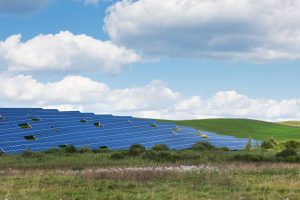
Perovskites containing lead and tin do not pose a threat per se to aquatic organisms and plants because the toxic compounds are bound or encapsulated in the product. Substances that can be released unintentionally due to environmental influences during the life cycle of the perovskite solar cells containing lead or tin are to be evaluated as critical. These include above all heavy metals, acids and other substances that have not yet been identified. The level of toxicity of the pollutants depends on the
solubility of the substances, but also on the pH of the environment (water, soil). Since these innovative perovskite solar cells are currently still in the research stage, there is only little data from the laboratory on the release quantities. Heavy metals themselves have already been well investigated toxicologically and existing limit values can be used in the future to better assess the risk to organisms from perovskite solar cells.
.
In an undamaged state, perovskite solar cells containing lead and tin do not pose a threat to environmental organisms. However, in the event of unwanted damage from environmental influences, degradation products can be released that have negative effects on organisms. According to current knowledge, replacing lead with tin in perovskite solar cells does not represent an alternative. Comparative studies with classic solar cells indicate that these too can release toxic substances. Perovskite solar cells based on lead or tin are currently (as of 2022) still part of the group of research materials and are not yet available in products on the market.
 Because solar cell perovskites are being researched in laboratories (status 2022), consumer do not come into contact with these materials at this time. Before solar cells perovskites are launched on the market, it must be ensured that they will not release toxic substances to humans and the environment. However, the perovskites currently being developed release the toxic heavy metals tin and lead, respectively, when they come into contact with water.
One possible way to prevent the release of lead and tin from solar cell perovskites would be to safely encapsulate them. This could be done by encasing them in glass. However, there are general safety concerns here, because if the glass is damaged, a release of the heavy metals would again be possible. The problem could be solved if the heavy metals in the solar cell perovskites were replaced by harmless elements or compounds, or if the release of toxic components were impossible.
Because solar cell perovskites are being researched in laboratories (status 2022), consumer do not come into contact with these materials at this time. Before solar cells perovskites are launched on the market, it must be ensured that they will not release toxic substances to humans and the environment. However, the perovskites currently being developed release the toxic heavy metals tin and lead, respectively, when they come into contact with water.
One possible way to prevent the release of lead and tin from solar cell perovskites would be to safely encapsulate them. This could be done by encasing them in glass. However, there are general safety concerns here, because if the glass is damaged, a release of the heavy metals would again be possible. The problem could be solved if the heavy metals in the solar cell perovskites were replaced by harmless elements or compounds, or if the release of toxic components were impossible.
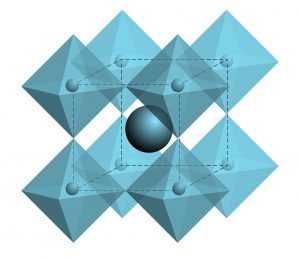
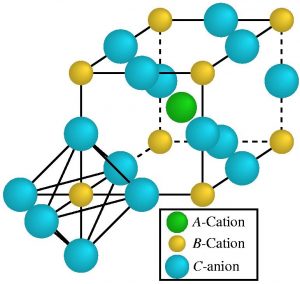
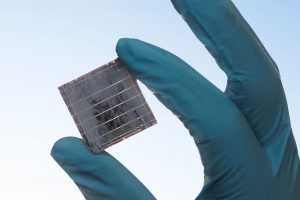
 For innovative solar cells, lead or tin based perovskites are currently being investigated as active components. However, the heavy metal